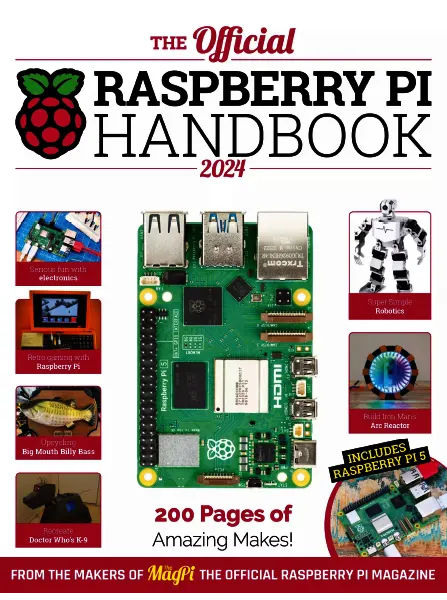
📘The Official Raspberry Pi Handbook 2025
The Official Raspberry Pi Handbook is the definitive guide to the world's most popular single-board computer, published by the Raspberry Pi Foundation. This comprehensive resource covers everything from basic setup to advanced projects, making it essential reading for beginners, hobbyists, educators, and experienced makers exploring the endless possibilities of Raspberry Pi computing.
🚀 The Official Raspberry Pi Handbook features over 200 pages of tutorials, projects, tips, and expert advice. Updated annually with the latest models, operating systems, and creative projects, it's the go-to resource trusted by millions in the global Raspberry Pi community.
200+ Pages of Content
50+ Step-by-Step Projects
Annual Publication
2025 Latest Edition
🎓
Beginner Friendly
Start from scratch
💡
Creative Projects
Build amazing things
🔧
Hardware Guides
Setup & configuration
💻
Programming Tutorials
Python, Scratch & more
🎯 What Makes This Handbook Special: Published directly by the Raspberry Pi Foundation—the creators of Raspberry Pi—this handbook provides authoritative, tested instructions and projects. It combines technical accuracy with accessible explanations, making complex computing concepts understandable for all skill levels.
🌟 Perfect For
- Complete Beginners: No prior experience needed—start your Raspberry Pi journey
- Students & Educators: Classroom-ready projects and learning activities
- Makers & Hobbyists: Expand your skills with creative builds
- Programmers: Learn Python, electronics, and physical computing
- Parents: Fun educational projects to do with children
- Tech Enthusiasts: Explore home automation, media centers, and more
💡 What You'll Learn: The handbook covers everything from unboxing your Raspberry Pi to building advanced projects like retro gaming consoles, weather stations, robotics, home security systems, and AI applications. Each tutorial includes detailed photos, code examples, and troubleshooting tips.
🔧About The Handbook
🏛️The Raspberry Pi Foundation
The Raspberry Pi Foundation is a UK-based educational charity founded in 2009 with the mission to put the power of computing and digital making into the hands of people worldwide. Since launching the first Raspberry Pi in 2012, over 60 million units have been sold, making it the best-selling British computer of all time.
📖 Handbook History
- First Edition (2020): Launched as the official guide to Raspberry Pi 4
- Annual Updates: New editions each year with latest hardware and software
- Community Driven: Projects contributed by educators, makers, and enthusiasts
- Global Reach: Translated into multiple languages worldwide
- Award Recognition: Praised for accessibility and educational value
💻Raspberry Pi Models Covered
🖥️
Raspberry Pi 5
Latest flagship model
💪
Raspberry Pi 4
Powerful all-rounder
📦
Raspberry Pi Zero 2
Compact & affordable
🏢
Raspberry Pi Pico
Microcontroller board
✍️Expert Contributors
The handbook features tutorials and projects from Raspberry Pi engineers, certified educators, professional developers, and community experts. Each project is tested, reviewed, and optimized to ensure success for readers at every skill level.
📍 Published By: Raspberry Pi Press, the official publishing arm of the Raspberry Pi Foundation. The press also publishes The MagPi magazine (the official Raspberry Pi magazine), HackSpace magazine, and numerous specialized books on programming, electronics, and making.
🎯Educational Mission
The handbook embodies the Raspberry Pi Foundation's mission to empower people through computing education. It's designed to be inclusive, encouraging creativity and problem-solving while teaching valuable STEM skills. Teachers worldwide use it as a curriculum resource, while hobbyists rely on it for inspiration and guidance.
🌍 The Raspberry Pi community spans over 190 countries, from schools in remote villages to innovation labs at Fortune 500 companies. The Official Handbook serves as the authoritative reference connecting this global community of makers and learners.
🏆 Why This Handbook Stands Out
- Official Authority: Direct from Raspberry Pi creators
- Tested Projects: Every tutorial verified to work
- Beginner Accessibility: Clear explanations without jargon
- Visual Learning: Full-color photos and diagrams
- Progressive Difficulty: Build skills step-by-step
- Community Support: Connect with millions of users
💻Handbook Content
📑Main Sections
🎓 Getting Started
- What is Raspberry Pi: Introduction to single-board computing
- Choosing Your Model: Compare features and select the right Pi
- Essential Accessories: Power supplies, cases, storage, and peripherals
- First Boot: Installing and configuring Raspberry Pi OS
- Desktop Tour: Navigate the operating system
- Basic Configuration: Network setup, updates, and preferences
💻 Programming Fundamentals
- Python Basics: Variables, loops, functions, and data structures
- Scratch Programming: Visual coding for beginners and children
- Linux Commands: Terminal navigation and file management
- GPIO Programming: Control hardware with Python
- Web Development: HTML, CSS, and JavaScript basics
- Database Basics: Store and manage data
🔧 Hardware & Electronics
- GPIO Pin Guide: Understanding the 40-pin header
- LED Control: Basic circuits and programming
- Sensors & Input: Temperature, motion, light detection
- Motor Control: Servos, steppers, and DC motors
- Camera Module: Photography and computer vision
- Display Integration: LCDs, OLEDs, and touchscreens
🎨Creative Projects
🎮 Retro Gaming Console
BeginnerTransform your Raspberry Pi into a classic arcade machine running thousands of retro games. Learn to install RetroPie, configure controllers, and add games legally.
🌡️ Weather Station
IntermediateBuild a complete weather monitoring system with temperature, humidity, pressure, and rainfall sensors. Display data on a website and create historical charts.
🤖 Robot Car
IntermediateConstruct a programmable robot vehicle with obstacle avoidance, line following, and remote control capabilities. Learn robotics fundamentals and motor control.
📸 Security Camera
IntermediateCreate a motion-detecting security camera with email alerts and web-based monitoring. Store footage and access remotely from anywhere.
🎵 Music Streaming Server
BeginnerSet up a personal music server to stream your collection throughout your home. Compatible with Spotify, internet radio, and local files.
🏠 Smart Home Hub
AdvancedBuild a comprehensive home automation system controlling lights, appliances, sensors, and more. Integrate with voice assistants and create automated routines.
🎓Educational Content
📚 Learning Paths
- Computing Basics: Binary, algorithms, and computer architecture
- Electronics Theory: Voltage, current, resistance, and circuit design
- Programming Concepts: Variables, loops, conditionals, and functions
- Networking Fundamentals: Protocols, IP addresses, and web services
- Cybersecurity: Encryption, passwords, and safe computing
- Physical Computing: Bridging digital and physical worlds
💡Special Features
🔍
Troubleshooting
Common issues & solutions
💬
Expert Tips
Pro advice & shortcuts
📦
Parts Lists
Components for each project
💾
Code Downloads
Ready-to-use programs
🎯 Project Difficulty Levels: Projects are clearly marked as Beginner, Intermediate, or Advanced, helping you choose appropriate challenges. Each includes estimated completion time, required components, and skill prerequisites.
🎯Featured Projects Gallery
🎮Gaming & Entertainment
🕹️ Arcade Cabinet
AdvancedBuild a full-size arcade cabinet with authentic controls, running classic arcade games. Includes woodworking plans, electronics integration, and game configuration.
📺 Media Center
BeginnerTransform any TV into a smart entertainment hub. Stream videos, play music, view photos, and access apps with LibreELEC or OSMC.
🎲 Tabletop Gaming Aid
IntermediateCreate a digital dice roller, character sheet manager, and ambient soundboard for D&D and other tabletop RPGs.
🏠Home & Productivity
🖼️ Digital Photo Frame
BeginnerDisplay rotating photos from cloud storage or local files. Add weather, calendar, and news widgets for a smart display.
🔊 Voice Assistant
IntermediateBuild your own privacy-focused voice assistant with offline speech recognition, custom commands, and smart home control.
📡 Network Storage (NAS)
IntermediateCreate a personal cloud storage server accessible from all your devices. Includes automatic backup and media streaming capabilities.
🖨️ Wireless Print Server
BeginnerMake any USB printer wireless and accessible from all devices on your network. Simple setup with CUPS printing system.
🔬Science & Education
🌱 Automated Plant Watering
IntermediateMonitor soil moisture and automatically water plants. Track growth data and receive alerts when attention is needed.
🔭 Telescope Controller
AdvancedControl a motorized telescope, capture astrophotography, and track celestial objects. Includes star charts and automated imaging.
🎓 Classroom Quiz Buzzer System
IntermediateBuild a multi-player quiz system with physical buzzers, score tracking, and customizable questions for interactive learning.
🔬 Science Data Logger
IntermediateRecord and analyze scientific experiments with multiple sensors. Export data to spreadsheets and create graphs automatically.
🤖Robotics & AI
👁️ Computer Vision System
AdvancedImplement facial recognition, object detection, and tracking using OpenCV and TensorFlow. Create AI-powered applications.
🦾 Robotic Arm
AdvancedBuild and program a multi-axis robotic arm with precise servo control. Perfect for learning inverse kinematics and automation.
🚗 Self-Driving Car
AdvancedCreate a miniature autonomous vehicle using computer vision and machine learning. Navigate courses and avoid obstacles independently.
💡 Every project in the handbook includes detailed step-by-step instructions, full-color photographs, circuit diagrams, complete code listings, and troubleshooting tips. Download supplementary files from the official Raspberry Pi website.
📥How to Access The Handbook
🌐Official Purchase Options
🏛️ Raspberry Pi Press
Purchase the official print or digital edition from Raspberry Pi Press Store↗. Available in physical paperback and downloadable PDF formats with worldwide shipping options.
📚 Major Retailers
Find the handbook at bookstores and online retailers including Amazon, Barnes & Noble, Book Depository, and specialist electronics stores. Often bundled with Raspberry Pi starter kits.
💰Pricing & Formats
💳 Available Formats
- Print Edition: Full-color paperback with glossy pages (typically $15-25)
- PDF Download: Digital version for immediate access (typically $10-15)
- Kindle/ePub: Compatible with e-readers and tablets
- Bundle Deals: Often included with Raspberry Pi starter kits
- Subscription: Get new editions automatically through MagPi subscriptions
📚Free Resources
🆓 Official Free Resources: While the full handbook is a paid product, Raspberry Pi offers extensive free resources:
📥PDF & Digital Archives
⚠️ Support the Raspberry Pi Foundation: While archives exist, purchasing the official handbook supports the Raspberry Pi Foundation's educational mission. Proceeds fund free computing education programs worldwide, helping children and adults learn valuable technology skills.
🎓Educational & Library Access
📖 Institutional Access
- School Libraries: Many schools stock handbooks for STEM programs
- Public Libraries: Check your local library catalog—often available to borrow
- University Makerspaces: Available in engineering and computer science departments
- Bulk Orders: Educational discounts for schools and organizations
- Digital Site Licenses: Available for institutions teaching Raspberry Pi
📱Companion Resources
📰 The MagPi Magazine
Subscribe to The MagPi↗, the official monthly Raspberry Pi magazine. Every issue includes new projects, tutorials, reviews, and community news. Free PDF downloads available.
📻 Raspberry Pi Podcast
Listen to the official podcast featuring interviews with makers, educators, and Raspberry Pi team members discussing projects and community news.
🎁 Gift Ideas: The handbook makes an excellent gift for:
- Students interested in computing and electronics
- New Raspberry Pi owners getting started
- Makers looking for project inspiration
- Teachers developing STEM curriculum
- Parents doing educational activities with children
- Anyone curious about technology and making
📚Getting the Most from Your Handbook
📖How to Use This Handbook
⚡ Reading Strategy
- Start at Your Level: Beginners start with Chapter 1; experienced users can jump ahead
- Hands-On Learning: Work through examples with your Raspberry Pi active
- Build Progressively: Each project builds on previous skills
- Bookmark Projects: Mark interesting projects to try later
- Keep It Handy: Reference while working—spiral binding or tablet version helps
- Join the Community: Share your builds and get help from fellow makers
- Experiment: Modify projects to suit your interests and learn by doing
🎯Essential Hardware to Get Started
🛒 Starter Kit Components
- Raspberry Pi Board: Pi 4 or 5 recommended for most projects (2GB+ RAM)
- Power Supply: Official USB-C power adapter (5V/3A minimum)
- MicroSD Card: 32GB or larger, Class 10 or better
- Case: Protects board and provides cooling
- HDMI Cable: Micro HDMI to HDMI for display connection
- USB Keyboard & Mouse: For setup and programming
- Optional: Heatsinks/Fan: For thermal management
💡 Budget Tip: Complete starter kits (around $100-150) include everything you need. Individual components often cost more separately. Look for official Raspberry Pi kits or bundles from authorized resellers.
🔧Recommended Tools & Supplies
🔌
Electronics
Breadboard, jumper wires, LEDs, resistors
🛠️
Tools
Screwdrivers, wire strippers, multimeter
📷
Modules
Camera, sensors, displays, HATs
📦
Storage
Component organizer, project boxes
💻Software Essentials
📱 Must-Have Software
- Raspberry Pi Imager: Easy OS installation tool
- Raspberry Pi OS: Official Debian-based operating system
- Thonny Python IDE: Beginner-friendly code editor
- Scratch: Visual programming for beginners
- Visual Studio Code: Advanced code editor for experienced programmers
- VNC Viewer: Remote desktop access
- PuTTY/SSH: Command-line remote access
🎓Learning Pathways
🚀 Beginner Path (4-6 weeks)
- Week 1: Setup Raspberry Pi, explore desktop, learn basic Linux commands
- Week 2: Python fundamentals—variables, loops, functions
- Week 3: GPIO basics—control LEDs and read buttons
- Week 4: First project—build a simple game or LED display
- Week 5: Sensors and input devices
- Week 6: Complete beginner project from handbook
🔧 Intermediate Path (8-12 weeks)
- Advanced Python programming (classes, modules, APIs)
- Web development with Flask or Django
- Database integration (SQLite, MySQL)
- Camera and computer vision basics
- Networking and IoT projects
- Building multi-component systems
🚀 Advanced Path (Ongoing)
- Machine learning and AI applications
- Robotics and autonomous systems
- Custom HAT design and PCB creation
- Cluster computing and parallel processing
- Contributing to open-source projects
- Creating tutorials for the community
💡Troubleshooting Tips
🔧 Common Issues & Solutions:
- Won't Boot: Check power supply (needs 5V/3A), verify SD card has OS
- No Display: Ensure HDMI cable secure, try different monitor/cable
- Overheating: Add heatsinks or fan, ensure adequate ventilation
- SD Card Corruption: Use quality cards, safely shut down before unplugging
- WiFi Issues: Update firmware, check router compatibility
- GPIO Not Working: Verify pin numbers, check connections, test with multimeter
🌐Community Resources
💬 Raspberry Pi Forums
Join Official Raspberry Pi Forums↗ with millions of helpful members. Get project help, share builds, and connect with makers worldwide.
🌍 Reddit Communities
Active communities at r/raspberry_pi↗ and related subreddits. Daily project showcases, troubleshooting help, and community discussions.
📚 GitHub Repositories
Thousands of open-source Raspberry Pi projects on GitHub↗. Find code, contribute to projects, and collaborate with developers globally.
🏆Project Showcase Opportunities
🌟 Share Your Builds
- The MagPi: Submit projects for potential publication
- Hackster.io: Detailed project hosting with community feedback
- Instructables: Step-by-step tutorials reach millions
- YouTube: Video builds gain subscribers and views
- Social Media: Twitter, Instagram with #RaspberryPi hashtag
- Local Maker Faires: Demonstrate projects in person
🎯Maximizing Learning Outcomes
📈 Effective Study Habits
- Regular Practice: Dedicate 30-60 minutes daily for hands-on work
- Document Progress: Keep a project journal or blog
- Fail Forward: Embrace errors as learning opportunities
- Teach Others: Explaining concepts solidifies understanding
- Join Study Groups: Local meetups or online communities
- Set Goals: Complete one project monthly
- Expand Horizons: Try projects outside your comfort zone
🚀 Your Raspberry Pi Journey: The Official Handbook is your roadmap to becoming a confident maker and programmer. Whether building your first LED circuit or developing complex AI systems, the handbook provides clear guidance, practical projects, and expert advice. Start with simple projects, build your skills progressively, and join millions of makers transforming their ideas into reality with Raspberry Pi.
📅 Stay Current: Technology evolves rapidly. The handbook is updated annually with new models, software updates, and fresh projects. Follow Raspberry Pi social media and subscribe to The MagPi for ongoing learning beyond the handbook.
🎁 Perfect Gift Package: Combine the handbook with a Raspberry Pi starter kit for the ultimate gift. Include:
- Official Raspberry Pi Handbook
- Raspberry Pi 4 or 5 starter kit
- Electronics component kit (LEDs, sensors, motors)
- MagPi magazine subscription
- Project-specific components for first build
This comprehensive package provides everything needed to start an exciting journey into computing, electronics, and making!
🌟 Why This Handbook Matters
- Accessible Education: Makes computing and electronics accessible to everyone
- Skill Development: Teaches valuable STEM skills for future careers
- Creative Empowerment: Transforms ideas into working projects
- Problem Solving: Develops critical thinking and debugging skills
- Community Connection: Joins you with millions of makers worldwide
- Lifelong Learning: Foundation for continuous education and growth
- Real-World Applications: Projects solve actual problems and needs
- Confidence Building: Success with projects builds self-efficacy