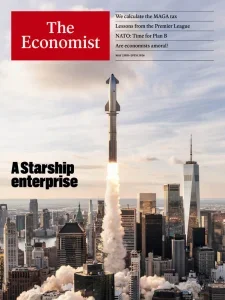
The Economist USA – May 23, 2026

Overview of the Issue

This issue appears to focus on four interconnected global themes:

  1. The resurgence of industrial and technological capitalism, centered on SpaceX and private-sector innovation.
  2. The contradictions of American economic strength, especially under “MAGAnomics.”
  3. The fragility of global security institutions, particularly NATO.
  4. Global health preparedness and pandemic risk, highlighted through the Ebola outbreak in Central Africa.

The issue’s editorial framing suggests a broader argument:
the world is entering a period where state capacity, private innovation, geopolitical fragmentation, and systemic resilience will define economic and political outcomes.


Main Articles and Key Insights

1. “A Starship Enterprise” — SpaceX and Modern Capitalism

One of the lead features reportedly argues that SpaceX represents “capitalism on rocket fuel.”

Core Themes

  • SpaceX is presented as an example of how competitive private enterprise can outperform traditional government-led aerospace models.
  • The company’s rapid innovation cycle, reusable rockets, and vertically integrated manufacturing are framed as evidence that:
    • markets can accelerate technological progress,
    • bureaucracy often slows innovation,
    • and ambitious engineering cultures can reshape entire industries.

Deeper Economic Interpretation

The article likely uses SpaceX as a symbol of a broader economic shift:

  • industrial policy + venture capital + national strategic goals are converging,
  • innovation ecosystems increasingly depend on founder-led firms,
  • governments are becoming dependent on private technological infrastructure.

This reflects a larger trend in modern capitalism:

  • the rise of “national champion” companies,
  • concentration of technological power,
  • and blurred boundaries between public and private sectors.

Likely Editorial Position

The magazine appears to admire the efficiency and ambition of the company while implicitly questioning:

  • whether democratic governments can still execute large-scale projects independently,
  • and whether concentrated private power creates new systemic risks.

2. “MAGAnomics Shows the World What Not To Do — and What America Gets Right”

This appears to be one of the issue’s most nuanced economic essays.

Central Argument

The article reportedly argues that:

  • certain nationalist or protectionist economic policies create distortions,
  • yet the underlying American economic model remains unusually dynamic.

Key Insights

The analysis likely distinguishes between:

  • America’s structural strengths, and
  • its political-economic excesses.

Structural strengths probably highlighted:

  • deep capital markets,
  • entrepreneurial culture,
  • labor mobility,
  • technological leadership,
  • research universities,
  • immigration-driven talent inflows.

Criticisms likely include:

  • tariff-heavy industrial policy,
  • fiscal populism,
  • rising public debt,
  • politicization of trade and monetary policy.

Important Underlying Thesis

The issue seems to argue that:

America succeeds not because it avoids mistakes, but because its institutions still allow rapid adaptation.

That is a classic Economist-style perspective:

  • markets remain productive despite political volatility,
  • innovation ecosystems compensate for governance inefficiencies,
  • and scale advantages continue to reinforce U.S. dominance.

Broader Implication

The article likely warns other countries against copying:

  • aggressive protectionism,
  • culture-war economics,
  • or debt-financed populism,
    while simultaneously acknowledging that the U.S. economy still outperforms many rivals.

3. “Why NATO Needs a Plan B”

This feature appears focused on the long-term stability of NATO.

Main Argument

The article reportedly challenges complacency around alliance durability and criticizes efforts to suppress discussion about NATO fragmentation risks.

Strategic Themes

The article likely explores:

  • reduced confidence in long-term American security guarantees,
  • European underinvestment in defense,
  • uncertainty created by shifting U.S. domestic politics,
  • and the possibility of a multipolar security order.

Key Geopolitical Insight

The core insight is probably:

Institutions survive only if members prepare for failure scenarios.

This is less about predicting NATO collapse and more about:

  • resilience planning,
  • defense industrial readiness,
  • and strategic autonomy for Europe.

Likely Recommendations

The article probably advocates:

  • stronger European defense coordination,
  • expanded military manufacturing capacity,
  • diversified command structures,
  • and contingency planning independent of U.S. leadership.

4. “How to Stop the Ebola Outbreak”

The issue also reportedly covers the Ebola epidemic in Central Africa.

Core Public Health Themes

The article likely emphasizes:

  • rapid detection systems,
  • vaccine deployment,
  • local healthcare infrastructure,
  • international coordination,
  • and surveillance capacity.

Broader Message

The Ebola discussion appears to function as a warning about:

  • future pandemics,
  • weakened global cooperation,
  • and declining preparedness after COVID-era fatigue.

Strategic Insight

The issue probably argues that:

  • pandemic prevention is cheaper than crisis response,
  • and fragmented geopolitics threatens effective health coordination.

This ties back into the issue’s broader theme:

modern systems are increasingly interconnected yet politically fragmented.


Cross-Issue Themes

Several ideas seem to connect the entire magazine:

1. Institutional Stress

Whether discussing:

  • NATO,
  • public health systems,
  • or economic governance,

the issue repeatedly points toward institutions under pressure from:

  • polarization,
  • geopolitical rivalry,
  • and technological disruption.

2. The Power of Private Actors

From SpaceX to capital markets, the issue suggests that:

  • private firms increasingly shape geopolitics,
  • innovation is concentrating in elite ecosystems,
  • and governments depend more heavily on corporate capability.

3. Resilience vs Efficiency

A recurring tension appears throughout the issue:

  • systems optimized for efficiency may become fragile,
  • while resilient systems require redundancy, investment, and planning.

This applies to:

  • defense alliances,
  • supply chains,
  • public health,
  • and industrial policy.

Overall Editorial Perspective

The issue seems broadly optimistic about:

  • innovation,
  • markets,
  • and technological capability,

but cautious about:

  • political instability,
  • institutional decay,
  • and geopolitical fragmentation.

The overarching message could be summarized as:

The modern world still generates extraordinary growth and innovation, but its supporting institutions are becoming less stable and less trusted.


The Economist USA – May 23, 2026
English | 84 pages | True PDF | 6.4 MB

Leave a Comment