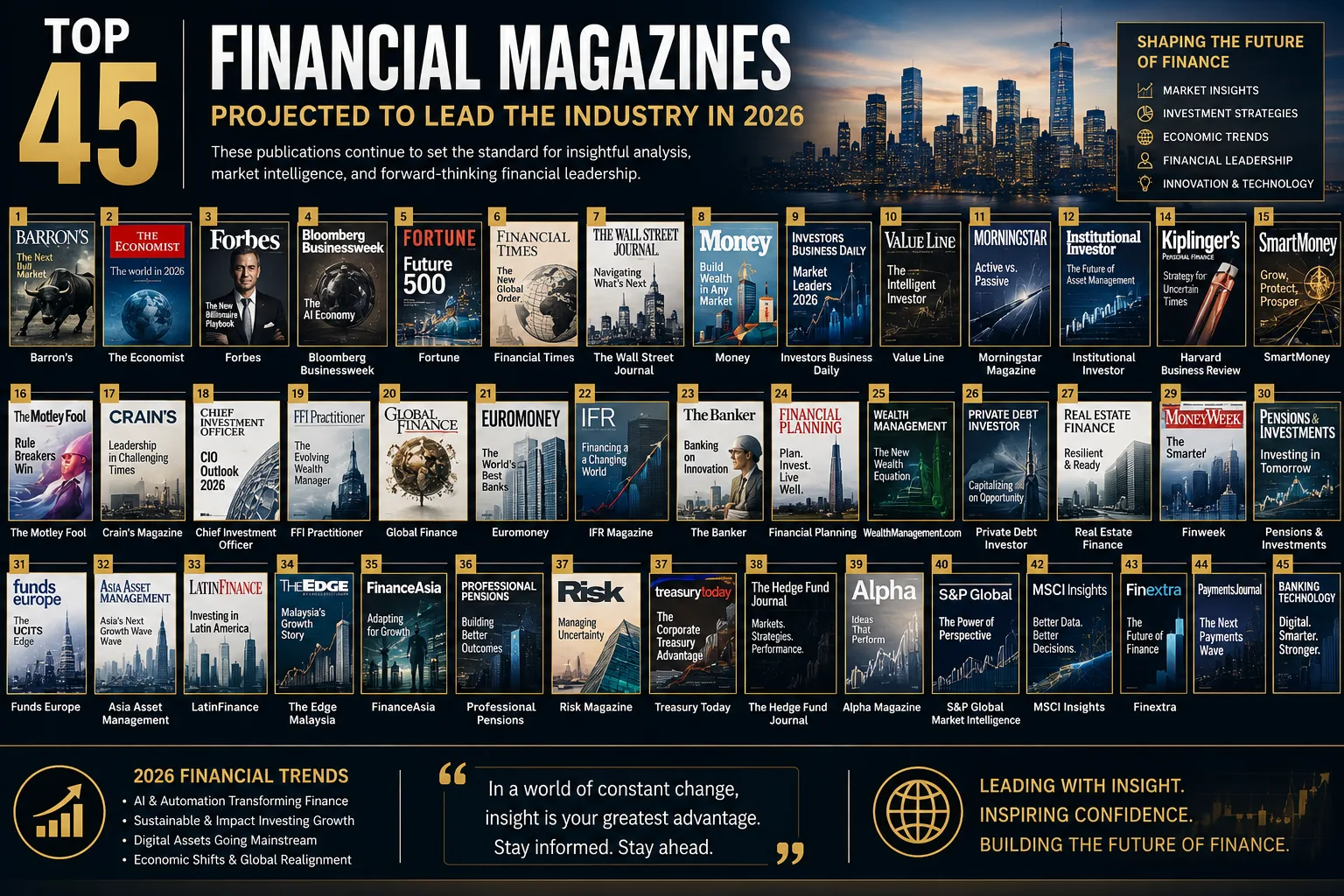
A Comprehensive Financial Media Industry Analysis
Executive Overview
The financial publishing landscape in 2026 continues to evolve rapidly as traditional print publications transform into multi-platform financial intelligence brands. The most influential financial magazines are no longer merely print products; they are integrated ecosystems combining premium journalism, digital subscriptions, podcasts, video programming, data platforms, newsletters, AI-assisted research tools, and live events.
The rankings below are based on:
- Editorial authority and reputation
- Audience size and engagement
- Digital transformation success
- Industry influence
- Quality of financial reporting
- Innovation in content delivery
- Relevance to investors, executives, advisors, and consumers
- Global reach and brand recognition
While exact circulation figures continue to fluctuate as digital subscriptions replace print, the estimates provided reflect current industry positioning and projected 2026 influence.
Tier 1: Global Financial Powerhouses
1. Forbes
Market Positioning: Wealth, entrepreneurship, investing, leadership, technology, and global business.
Circulation & Reach: Print circulation exceeds 500,000 with tens of millions of monthly digital readers globally. (Wikipédia)
Geographic Focus: Global.
Digital Presence: Exceptional; extensive digital publishing, video content, podcasts, newsletters, and international editions.
Editorial Reputation: Highly influential despite ongoing debates about contributor-generated content.
2026 Innovation Trends: AI-enhanced financial analysis, interactive rankings, personalized investor intelligence.
2. Fortune
Market Positioning: Corporate leadership, markets, investing, executive strategy, and economic trends.
Circulation & Reach: Historically over 850,000 circulation with strong digital readership. (Wikipédia)
Geographic Focus: Global.
Digital Presence: Premium subscription model, podcasts, leadership summits, newsletters.
Editorial Reputation: Among the most respected business journalism brands worldwide.
2026 Innovation Trends: Executive intelligence platforms, ESG coverage, AI-driven business forecasting.
3. Bloomberg Businessweek
Market Positioning: Markets, economics, corporations, technology, and global finance.
Circulation & Reach: Hundreds of thousands of subscribers supported by Bloomberg’s vast terminal ecosystem.
Geographic Focus: Global.
Digital Presence: Strong integration with Bloomberg digital products and multimedia.
Editorial Reputation: Elite financial journalism and investigative reporting.
2026 Innovation Trends: Real-time market storytelling and integrated data visualization.
4. The Economist
Market Positioning: Macroeconomics, geopolitics, global finance, public policy.
Circulation & Reach: More than one million global subscribers across print and digital channels.
Geographic Focus: Global.
Digital Presence: Exceptional mobile, podcast, video, and subscriber ecosystem.
Editorial Reputation: Gold standard for economic analysis.
2026 Innovation Trends: Predictive economic modeling and geopolitical risk intelligence.
5. Barron’s
Market Positioning: Investing, wealth management, markets, securities analysis.
Circulation & Reach: More than 300,000 circulation with substantial digital growth. (Wikipédia)
Geographic Focus: Primarily U.S. with global market coverage.
Digital Presence: Premium subscriber platform with extensive market tools.
Editorial Reputation: One of the most trusted investing publications globally.
2026 Innovation Trends: AI-assisted stock screening and portfolio intelligence.
Tier 2: Premier Investment Publications
6. Investor’s Business Daily
Focus: Growth investing and stock market strategy.
Audience: Active investors and traders.
Geographic Reach: Primarily U.S.
Digital Strength: Strong digital-first transformation.
Editorial Quality: Highly respected among growth investors.
2026 Outlook: Enhanced screening tools and quantitative investing content.
7. Kiplinger Personal Finance
Focus: Personal finance, retirement, taxes, investing.
Circulation: Historically over 600,000 subscribers. (Wikipédia)
Audience: Affluent households and retirees.
Geographic Reach: U.S. national.
Editorial Quality: Trusted consumer finance authority.
2026 Outlook: Personalized retirement planning tools and financial wellness platforms.
8. Money
Focus: Consumer finance and wealth building.
Audience: Mainstream consumers.
Reach: Large digital audience after print transformation.
Editorial Reputation: Long-standing personal finance authority.
2026 Trends: Interactive planning tools and AI budgeting assistants.
9. Morningstar Magazine
Focus: Mutual funds, ETFs, retirement planning.
Audience: Advisors and sophisticated investors.
Reach: Global.
Editorial Reputation: Research-driven and highly credible.
2026 Trends: Data-rich investor education.
10. Worth
Focus: High-net-worth wealth management.
Audience: Affluent investors and family offices.
Reach: National and international.
Editorial Reputation: Strong luxury-finance crossover appeal. (Wikipédia)
2026 Trends: Family office intelligence and impact investing.
Tier 3: Wealth Management & Advisor Publications
11. Financial Advisor Magazine
Focus: Financial planning and wealth management.
Audience: Registered investment advisors.
Reach: More than 100,000 monthly readers. (Blitz Sales Software)
Editorial Reputation: Industry-leading advisor publication.
2026 Trends: Practice-management technology coverage.
12. InvestmentNews
Focus: Wealth management industry.
Audience: Advisors and RIAs.
Reach: North America.
Editorial Quality: Strong industry reporting.
2026 Trends: Consolidation and advisor technology analysis.
13. ThinkAdvisor
Focus: Advisor strategies and retirement planning.
Audience: Financial professionals.
Digital Strength: High.
2026 Trends: AI-powered advisory practices.
14. WealthManagement.com
Focus: Wealth advisory industry.
Audience: Professional advisors.
Editorial Reputation: Major industry authority.
2026 Trends: Advisor technology and succession planning.
15. RIA Intel
Focus: Independent advisory firms.
Audience: RIAs.
2026 Trends: Regulatory technology and independent advisory growth.
Tier 4: Institutional Finance & Corporate Markets
16. Institutional Investor
Focus: Asset management and institutional investing.
Audience: Pension funds, hedge funds, asset managers.
Global Reach: Strong.
2026 Trends: Alternative assets and private markets.
17. Treasury & Risk
Focus: Corporate finance and risk management.
Audience: CFOs and treasurers.
2026 Trends: Treasury digitization.
18. Global Finance
Focus: International banking and finance.
Audience: Bank executives and institutional investors.
Reach: Global.
2026 Trends: Cross-border payments and digital banking.
19. Euromoney
Focus: Banking, capital markets, and international finance.
Audience: Institutional finance professionals.
2026 Trends: Global capital market transformation.
20. The Banker
Focus: Global banking.
Audience: Bank executives.
Reputation: Benchmark publication in banking.
2026 Trends: Central bank digital currencies and fintech partnerships.
Tier 5: Fintech and Innovation Leaders
21. FinTech Magazine
22. PaymentsJournal
23. Bank Automation News
24. Finextra
25. American Banker
These publications focus on:
- Digital banking
- Payments innovation
- Open banking
- Embedded finance
- Banking technology
- Artificial intelligence in finance
By 2026, fintech-focused publications are among the fastest-growing segments of financial media as traditional finance converges with technology.
Tier 6: Trading & Capital Markets Specialists
26. Stocks & Commodities
27. Traders Magazine
28. Futures Magazine
29. ETF.com
30. The Hedge Fund Journal
Key 2026 themes:
- Quantitative trading
- Algorithmic investing
- ETF expansion
- Alternative investments
- Private credit markets
Tier 7: Private Wealth & Luxury Finance
31. Private Wealth Magazine
32. Family Wealth Report
33. Citywire Wealth Manager
34. PWM
35. Robb Report
These titles increasingly combine:
- Wealth management
- Lifestyle finance
- Family office strategy
- Philanthropy
- Legacy planning
Tier 8: International Financial Publications
36. Asian Banking & Finance
37. FinanceAsia
38. The Asset
39. LatinFinance
40. African Banker
These magazines are increasingly important because investment flows and economic growth opportunities continue expanding outside traditional North American and European markets.
Tier 9: Emerging Digital-First Finance Publications
41. The Information
42. Axios Pro Finance
43. Semafor Business
44. Pensions & Investments
45. Chief Investment Officer
These digital-native brands are reshaping financial journalism through:
- Subscription-first business models
- Specialized newsletters
- Data journalism
- AI-assisted research
- Executive briefings
Major Industry Trends Shaping Financial Magazines in 2026
1. AI-Powered Financial Journalism
Virtually every major financial publication is integrating AI into:
- Earnings analysis
- Market monitoring
- Content personalization
- Portfolio insights
- News summarization
Human editorial oversight remains essential, but AI significantly improves speed and scale.
2. Newsletter-Centric Publishing
The most successful financial publishers now derive substantial engagement from premium newsletters rather than traditional magazine issues.
Leading examples include:
- Forbes
- Bloomberg Businessweek
- Barron’s
- The Economist
- Fortune
These newsletters increasingly serve as primary subscriber touchpoints.
3. Video and Podcast Expansion
Financial audiences increasingly consume content through:
- Market briefings
- CEO interviews
- Investment podcasts
- Livestream market coverage
- On-demand educational series
As a result, financial magazines increasingly resemble multimedia networks rather than print publishers.
4. Wealth Management Boom
The growth of affluent investors, retirees, and family offices continues driving demand for:
- Retirement planning
- Tax optimization
- Estate planning
- Alternative investments
- Private market opportunities
Publications serving advisors and wealthy individuals are expected to experience some of the strongest growth through 2026.
5. ESG Evolves into Sustainability and Resilience
While ESG branding has become more nuanced, investor demand for sustainability reporting remains strong.
Coverage increasingly focuses on:
- Climate risk
- Energy transition
- Corporate resilience
- Supply-chain sustainability
- Long-term value creation
6. Fintech Convergence
The distinction between finance and technology publishing continues to disappear.
Major editorial themes include:
- Digital banking
- Stablecoins
- Tokenization
- Embedded finance
- AI investing
- Real-time payments
Final Assessment
The most influential financial magazines of 2026 are no longer simply magazines—they are integrated financial intelligence platforms. Publications such as Forbes, Fortune, Bloomberg Businessweek, The Economist, Barron’s, Kiplinger, and Institutional Investor remain the industry’s most powerful editorial brands due to their combination of credibility, reach, digital innovation, and influence on investors, executives, policymakers, and financial professionals worldwide. (Forbes)
Looking ahead, the publications best positioned for success will be those that combine trusted journalism with data analytics, AI-enhanced personalization, premium communities, events, podcasts, and real-time financial intelligence services. In many cases, the magazine itself will become only one component of a much larger financial information ecosystem.