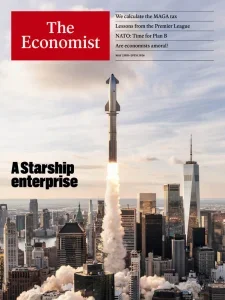
The Economist USA – May 23, 2026

Overview of the Issue

This issue appears to focus on four interconnected global themes:

  1. The resurgence of industrial and technological capitalism, centered on SpaceX and private-sector innovation.
  2. The contradictions of American economic strength, especially under “MAGAnomics.”
  3. The fragility of global security institutions, particularly NATO.
  4. Global health preparedness and pandemic risk, highlighted through the Ebola outbreak in Central Africa.

The issue’s editorial framing suggests a broader argument:
the world is entering a period where state capacity, private innovation, geopolitical fragmentation, and systemic resilience will define economic and political outcomes.


Main Articles and Key Insights

1. “A Starship Enterprise” — SpaceX and Modern Capitalism

One of the lead features reportedly argues that SpaceX represents “capitalism on rocket fuel.”

Core Themes

  • SpaceX is presented as an example of how competitive private enterprise can outperform traditional government-led aerospace models.
  • The company’s rapid innovation cycle, reusable rockets, and vertically integrated manufacturing are framed as evidence that:
    • markets can accelerate technological progress,
    • bureaucracy often slows innovation,
    • and ambitious engineering cultures can reshape entire industries.

Deeper Economic Interpretation

The article likely uses SpaceX as a symbol of a broader economic shift:

  • industrial policy + venture capital + national strategic goals are converging,
  • innovation ecosystems increasingly depend on founder-led firms,
  • governments are becoming dependent on private technological infrastructure.

This reflects a larger trend in modern capitalism:

  • the rise of “national champion” companies,
  • concentration of technological power,
  • and blurred boundaries between public and private sectors.

Likely Editorial Position

The magazine appears to admire the efficiency and ambition of the company while implicitly questioning:

  • whether democratic governments can still execute large-scale projects independently,
  • and whether concentrated private power creates new systemic risks.

2. “MAGAnomics Shows the World What Not To Do — and What America Gets Right”

This appears to be one of the issue’s most nuanced economic essays.

Central Argument

The article reportedly argues that:

  • certain nationalist or protectionist economic policies create distortions,
  • yet the underlying American economic model remains unusually dynamic.

Key Insights

The analysis likely distinguishes between:

  • America’s structural strengths, and
  • its political-economic excesses.

Structural strengths probably highlighted:

  • deep capital markets,
  • entrepreneurial culture,
  • labor mobility,
  • technological leadership,
  • research universities,
  • immigration-driven talent inflows.

Criticisms likely include:

  • tariff-heavy industrial policy,
  • fiscal populism,
  • rising public debt,
  • politicization of trade and monetary policy.

Important Underlying Thesis

The issue seems to argue that:

America succeeds not because it avoids mistakes, but because its institutions still allow rapid adaptation.

That is a classic Economist-style perspective:

  • markets remain productive despite political volatility,
  • innovation ecosystems compensate for governance inefficiencies,
  • and scale advantages continue to reinforce U.S. dominance.

Broader Implication

The article likely warns other countries against copying:

  • aggressive protectionism,
  • culture-war economics,
  • or debt-financed populism,
    while simultaneously acknowledging that the U.S. economy still outperforms many rivals.

3. “Why NATO Needs a Plan B”

This feature appears focused on the long-term stability of NATO.

Main Argument

The article reportedly challenges complacency around alliance durability and criticizes efforts to suppress discussion about NATO fragmentation risks.

Strategic Themes

The article likely explores:

  • reduced confidence in long-term American security guarantees,
  • European underinvestment in defense,
  • uncertainty created by shifting U.S. domestic politics,
  • and the possibility of a multipolar security order.

Key Geopolitical Insight

The core insight is probably:

Institutions survive only if members prepare for failure scenarios.

This is less about predicting NATO collapse and more about:

  • resilience planning,
  • defense industrial readiness,
  • and strategic autonomy for Europe.

Likely Recommendations

The article probably advocates:

  • stronger European defense coordination,
  • expanded military manufacturing capacity,
  • diversified command structures,
  • and contingency planning independent of U.S. leadership.

4. “How to Stop the Ebola Outbreak”

The issue also reportedly covers the Ebola epidemic in Central Africa.

Core Public Health Themes

The article likely emphasizes:

  • rapid detection systems,
  • vaccine deployment,
  • local healthcare infrastructure,
  • international coordination,
  • and surveillance capacity.

Broader Message

The Ebola discussion appears to function as a warning about:

  • future pandemics,
  • weakened global cooperation,
  • and declining preparedness after COVID-era fatigue.

Strategic Insight

The issue probably argues that:

  • pandemic prevention is cheaper than crisis response,
  • and fragmented geopolitics threatens effective health coordination.

This ties back into the issue’s broader theme:

modern systems are increasingly interconnected yet politically fragmented.


Cross-Issue Themes

Several ideas seem to connect the entire magazine:

1. Institutional Stress

Whether discussing:

  • NATO,
  • public health systems,
  • or economic governance,

the issue repeatedly points toward institutions under pressure from:

  • polarization,
  • geopolitical rivalry,
  • and technological disruption.

2. The Power of Private Actors

From SpaceX to capital markets, the issue suggests that:

  • private firms increasingly shape geopolitics,
  • innovation is concentrating in elite ecosystems,
  • and governments depend more heavily on corporate capability.

3. Resilience vs Efficiency

A recurring tension appears throughout the issue:

  • systems optimized for efficiency may become fragile,
  • while resilient systems require redundancy, investment, and planning.

This applies to:

  • defense alliances,
  • supply chains,
  • public health,
  • and industrial policy.

Overall Editorial Perspective

The issue seems broadly optimistic about:

  • innovation,
  • markets,
  • and technological capability,

but cautious about:

  • political instability,
  • institutional decay,
  • and geopolitical fragmentation.

The overarching message could be summarized as:

The modern world still generates extraordinary growth and innovation, but its supporting institutions are becoming less stable and less trusted.


The Economist USA – May 23, 2026
English | 84 pages | True PDF | 6.4 MB

The 5 Best PDF Readers for Digital Magazines in 2026

Reading digital magazines on a screen is a completely different experience from reading on paper — and the right PDF reader can make or break that experience. Whether you're flipping through a glossy fashion magazine, a dense technical journal, or a comic-style publication, your reader app affects everything from page-turn smoothness to night-time eye comfort.

Here's our breakdown of the five best PDF readers for digital magazine lovers, complete with pros, cons, and who each one is best suited for.

1. Adobe Acrobat Reader

The industry standard, and for good reason.

Adobe Acrobat Reader remains the gold standard for PDF viewing across desktop, mobile, and web. For digital magazines packed with embedded fonts, vector graphics, and interactive elements, Acrobat renders everything with pixel-perfect accuracy.

✅ Pros

  • Universal compatibility — opens any PDF without rendering issues
  • Liquid Mode reflows magazine layouts for small screens
  • Cloud sync across devices
  • Free annotation and highlighting tools

❌ Cons

  • Can feel heavy/slow on older devices
  • Frequent update prompts
  • Some premium features locked behind subscription

Best for: Readers who want maximum compatibility and don't mind a slightly heavier app.

2. Xodo PDF Reader & Editor

Lightweight, fast, and beautifully minimal.

Xodo has become a favorite among magazine readers who want speed without sacrificing features. It's completely free, ad-light, and handles large magazine files (100MB+) without lag.

✅ Pros

  • Blazing-fast page rendering, even for image-heavy issues
  • Dual-page "spread" view for tablets — mimics a real magazine
  • Excellent night mode with adjustable warmth
  • Free cloud storage integration (Google Drive, Dropbox, OneDrive)

❌ Cons

  • Mobile-only focus (desktop version is more limited)
  • Fewer advanced editing tools than Acrobat

Best for: Tablet readers who want that authentic "two-page spread" magazine feel.

3. Foxit PDF Reader

The power-user's choice.

Foxit strikes a great balance between performance and features. It's particularly popular for magazines that include forms, hyperlinks, and bookmarked sections (common in tech and business publications).

✅ Pros

  • Extremely fast startup and load times
  • Excellent bookmark/table-of-contents navigation
  • Built-in PDF compression (great for archiving large magazine collections)
  • Strong security features (password protection, redaction)

❌ Cons

  • Interface feels slightly more "corporate" than reader-focused
  • Some tools require Foxit PDF Editor (paid)

Best for: Readers who download and archive large magazine libraries.

4. SumatraPDF

Minimalist. Lightning-fast. Open-source.

If you're a desktop reader on Windows who values speed above all else, SumatraPDF is unbeatable. It opens instantly, has zero bloat, and supports keyboard-driven navigation perfect for power-reading through issue after issue.

✅ Pros

  • Opens massive PDFs almost instantly
  • Tiny install size (a few MB)
  • Continuous scroll mode great for long-form magazine articles
  • Free, open-source, no ads ever

❌ Cons

  • Windows-only
  • No cloud sync
  • Very basic annotation tools

Best for: Windows users who binge-read magazine archives and want zero friction.

5. Apple Books / Preview (macOS & iOS)

Seamless if you're already in the Apple ecosystem.

For iPhone, iPad, and Mac users, the built-in PDF tools in Apple Books and Preview offer a surprisingly polished magazine-reading experience — especially with iPad's larger screen and Apple Pencil annotation support.

✅ Pros

  • Beautiful, distraction-free reading view
  • Seamless iCloud sync across all Apple devices
  • Apple Pencil markup feels natural for notes/highlights
  • No installation needed — it's already there

❌ Cons

  • Apple ecosystem only
  • Limited file management compared to dedicated PDF apps
  • Fewer customization options for page layout

Best for: iPad readers who want a clean, native experience with zero setup.

Quick Comparison Table

ReaderPlatformBest FeaturePrice
Adobe Acrobat ReaderAllLiquid Mode reflowFree / Premium
XodoMobile/TabletTwo-page spread viewFree
Foxit ReaderDesktopTOC navigation & compressionFree / Pro
SumatraPDFWindowsSpeed & minimalismFree
Apple Books/PreviewApple devicesNative iCloud integrationFree

Final Thoughts

There's no single "best" PDF reader for everyone — it really depends on your device and reading habits:

  • Tablet flippers → go with Xodo
  • Windows speed-readers → go with SumatraPDF
  • Apple users → stick with Apple Books
  • Archivists & collectorsFoxit is your friend
  • Need it to "just work" everywhereAdobe Acrobat

Whichever you choose, downloading high-quality digital magazine PDFs is the first step to a great reading experience — and that's exactly what we're here for.

Want more reading tips and the latest free magazine downloads? Browse our growing archive and find your next favorite issue today.

Leave a Comment